Month: September 2026

Allen Joe – The Man Behind the Legend

When people hear the name Allen Joe, many will immediately think of Bruce Lee.

But Allen Joe had already accomplished a great deal before he ever met Bruce.

Allen was born in 1924 and grew up in Oakland, California. As a young man, he became interested in bodybuilding after experiencing bullying. Instead of allowing that experience to define him, he turned to training and physical development.

He eventually became a serious bodybuilder and trained under Ed Yarick, alongside some of the best-known bodybuilders of the time, including Jack Delinger, Roy Hilligenn, Clancy Ross and Steve Reeves.

In 1946, Allen became the first Asian American to win the Mr. Northern California Bodybuilding Championship.

At a time when bodybuilding was still very different from what it is today, this was a remarkable achievement.

Allen was also a World War II veteran, and his life was about much more than martial arts.

Meeting Bruce Lee

Allen met Bruce Lee in Seattle in 1962.

Bruce was immediately impressed by Allen’s physical development and knowledge of bodybuilding. Their friendship continued after Bruce moved to Oakland, where Allen became part of a small group of martial artists and friends that became known as the “Four Musketeers” Bruce Lee, Allen Joe, James Yimm Lee and George Lee.

The name “Four Musketeers” was also used by Allen himself when he later described their friendship and time together.

Allen and James introduced Bruce to basic weight training and body conditioning. Allen also gave Bruce his first set of weights.

This became an important part of Bruce’s development.

Bruce was already an exceptional martial artist, but he was constantly looking for ways to improve himself physically. Weight training, conditioning and strength development became an increasingly important part of his training.

Allen later recalled that their early workouts were actually quite simple: basic exercises such as squats, pullovers and curls.

Nothing complicated.

Just hard work and consistency.

More Than Bruce Lee’s Friend

What I find particularly interesting about Allen is that his own story can easily disappear behind the much bigger story of Bruce Lee.

But Allen was not simply “Bruce Lee’s friend.”

He was a champion bodybuilder in his own right, a veteran, a martial artist, a trainer and someone who had dedicated much of his life to physical development.

He also remained interested in training throughout his life.

Even at the age of 92, Allen was still lifting weights.

That says something about the man he was.

For Allen, training was not simply something you did for a few years when you were young. It was part of his way of life.

The Four Musketeers

There is something fascinating about that small group in Oakland.

Four very different men, brought together through martial arts, friendship and a shared interest in pushing themselves further.

Bruce Lee.

James Yimm Lee.

George Lee.

Allen Joe.

Each of them contributed something different.

James was an experienced martial artist and an important mentor to Bruce.

George was a skilled craftsman who built and modified much of Bruce’s training equipment.

And Allen brought his knowledge of bodybuilding and physical conditioning.

Together, they were part of the environment in which Bruce Lee continued to experiment, train and develop his ideas.

Remembering Allen

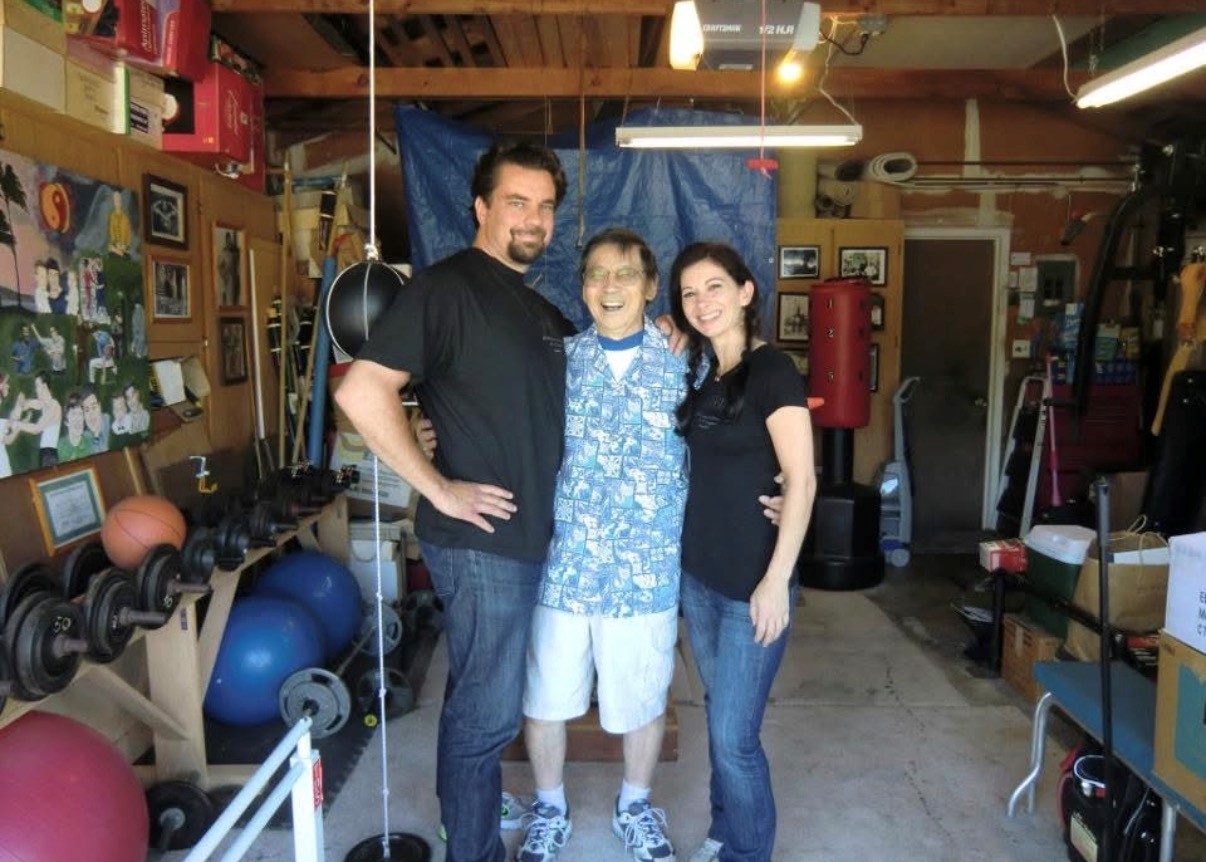
I was fortunate enough to know Allen personally.

That makes the historical stories mean something different to me.

I didn’t meet a name from a book.

I met the man.

And perhaps that is what I remember most.

Behind the photographs of Allen standing beside Bruce Lee was a man who had lived a long and remarkable life of his own.

A bodybuilder.

A martial artist.

A veteran.

A husband.

A friend.

And someone who continued to train and stay active throughout his life.

Allen passed away on April 2, 2018, at the age of 94.

I feel very fortunate that our paths crossed.

Rest in peace, Allen.

Walk on.
The History of JKD Sweden

JKD Sweden – Jeet Kune Do in the Ted Wong lineage

JKD Sweden was established in 2004 and grew out of a genuine dedication to studying Bruce Lee’s Jeet Kune Do.

From the beginning, our training has been shaped by the teachings we received through our instructors and, importantly, through our direct contact with Sigung Ted Wong.

Ted Wong personally authorized our group in Sweden, and his teachings remain an important part of our understanding and practice of Jeet Kune Do.

How it began

My own journey with Jeet Kune Do began in Stockholm in 2004.

I had been fascinated by Bruce Lee and martial arts for many years, but had never had the opportunity to train in Jeet Kune Do. After moving to Sweden, I discovered that Jun Fan Jeet Kune Do was being taught in Stockholm and began training.

That same year, I attended a seminar with Ted Wong in Nynäshamn.

Meeting Ted was a turning point.

His teaching, his calmness and his way of explaining Jeet Kune Do made a lasting impression on me. It was the beginning of a journey that would become a very important part of my life.

It was also through this period that I met Mikael Egidéus, who became my instructor and with whom JKD Sweden was subsequently created.

Our connection to Ted Wong

For JKD Sweden, Ted Wong was not simply an important name in the history of Jeet Kune Do.

He was our Sifu.

We had the opportunity to meet him, train with him and learn from him personally. His approach to Jeet Kune Do had a profound influence on the way we understood the art.

Ted personally authorized JKD Sweden as a Jeet Kune Do training group in Sweden.

This is an important part of our history and remains one of the foundations of JKD Sweden.

Ted’s teaching emphasised simplicity, efficiency, timing, distance, footwork, balance and proper movement. Just as importantly, he encouraged students to understand what they were doing rather than simply copying techniques.

Those principles continue to influence our training.

More than twenty years of Jeet Kune Do

Over the years, JKD Sweden developed through regular training, seminars, sparring and the dedication of its members.

Jeet Kune Do became much more than a martial art that we trained.

It became a journey.

Through training, we made friendships, travelled, met people who were part of Bruce Lee’s and Ted Wong’s history, and experienced many moments that we will always remember.

We travelled to San Francisco on several occasions and had the opportunity to visit places connected to Bruce Lee and meet people from his circle. In 2010, we were there for the celebration of Bruce Lee’s 70th birthday.

These experiences became an important part of our journey, but the heart of it has always been the training.

What Jeet Kune Do means to us

For us, Jeet Kune Do is not simply a collection of techniques.

It is a way of learning how to move, how to understand timing and distance, how to remain relaxed and efficient, and how to adapt.

The longer we train, the more we realise that there is always something more to learn.

This is one of the things that has kept Jeet Kune Do meaningful to us for more than twenty years.

Continuing Ted Wong’s legacy

Ted Wong passed away in 2010, but his influence did not end with his passing.

The knowledge and principles he shared continue through the people he taught and through those who continue to study and practise what he passed on.

For us, preserving Ted’s legacy is not simply about looking back at the past.

It is about continuing to train.

It is about continuing to learn.

And it is about maintaining the principles and training methods that were passed on to us.

JKD Sweden today

Today, JKD Sweden is no longer a recruiting training group and we are not currently accepting new students.

We have chosen instead to focus on our own training, continued development and deeper understanding of Jeet Kune Do.

The group may be different from what it was during the earlier years, but the foundation remains.

The experiences, knowledge and lessons gained over more than twenty years continue to shape our practice.

Our journey continues

JKD Sweden began with a desire to learn Bruce Lee’s Jeet Kune Do.

More than twenty years later, that journey continues.

We remain grateful for the people who have taught us, the training partners who have shared the journey, and especially for the opportunity we had to learn directly from Ted Wong.

Our history is part of who we are, but Jeet Kune Do is something that must continue to be practised, understood and explored.

That is what we continue to do.

Walk on.

More Than 20 Years of Jeet Kune Do: What I Have Learned Since 2004

In 2004, I started training Jeet Kune Do. At the time, I had no idea that it would become such an important part of my life.

I had always been fascinated by Bruce Lee, but training in his art was never something that was available to me when I lived in France. I began training at the Stefan Nikander School in Stockholm and later that year I had the opportunity to attend a seminar with Ted Wong.

Meeting Ted was a turning point for me. His calmness, kindness and way of teaching made a lasting impression. Over the years, JKD became much more than learning techniques. It brought friendships, travel, hard training, injuries, challenges and memories that I will carry with me for the rest of my life.

Through JKD, Mikael and I had the opportunity to travel to San Francisco and visit places connected to Bruce Lee, meet people from his circle, and celebrate Bruce Lee’s 70th birthday in 2010. These experiences are a big part of what makes this journey so meaningful.

Over more than twenty years, life has changed. People have moved on, training groups have become smaller, and injuries and other responsibilities have sometimes made training difficult. But the journey never really stopped.

Today, we are focusing on our own personal journeys, continuing to train, learn, refine, and deepen our understanding of Jeet Kune Do.

Looking back, I have learned that JKD is not about collecting techniques or becoming perfect. It is about learning, adapting, staying curious and continuing to move forward. It is also a way of life.

Walk on.